UNLATCHED
Designing for Emotional Authenticity in Online Dating
Exploring a dual-profile system that balances vulnerability with safety
Creating a Dating App Where Authenticity Feels Safe
When people join a dating app, they often feel pressure to present the “perfect” version of themselves. That usually means polished photos, witty lines, and carefully selected traits. But in interviews, we kept hearing the same frustrations: “It all feels fake.” People wanted something more real, yet they feared being judged if they shared too much too soon.
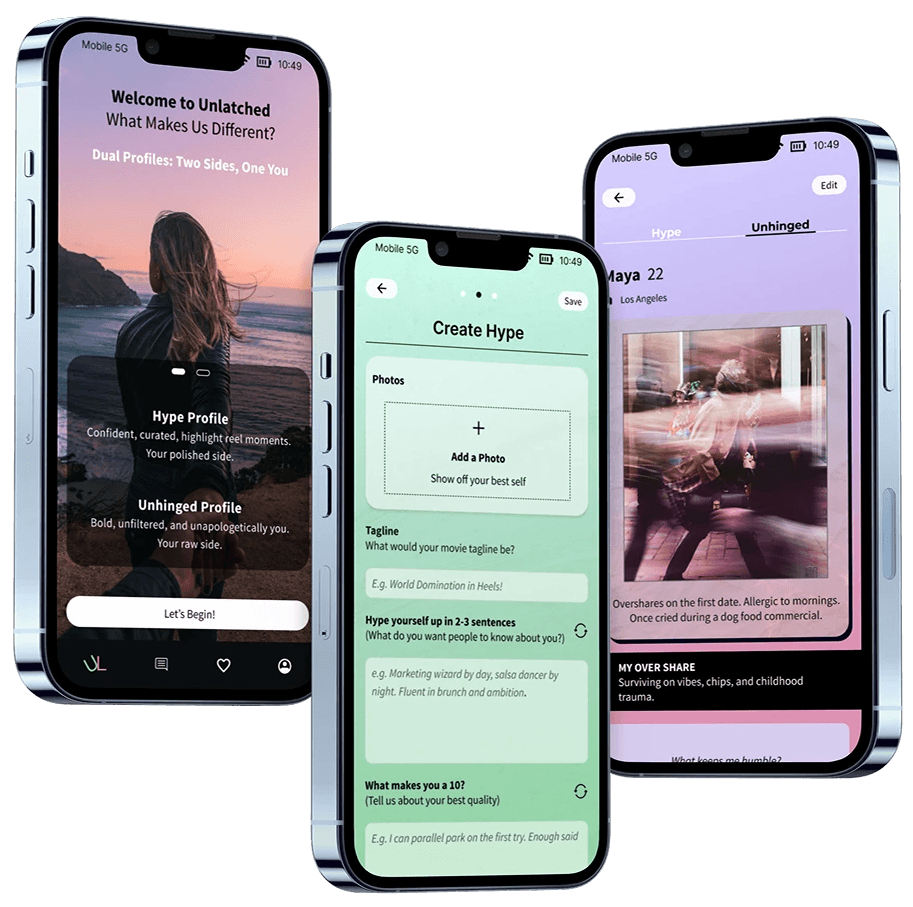
That tension is what Unlatched set out to solve. Instead of asking people to squeeze into one polished profile, the concept allowed for two: a confident, curated “Hype” side and a vulnerable, unfiltered “Unhinged” side. My role was to validate this dual-profile idea, test whether people would embrace it, and design a flow that made honesty feel safe.
The project lasted 5 weeks, and I worked end-to-end as the product designer, from research to high-fidelity prototypes. Along the way, I discovered that building emotional safety into design isn’t about flashy features, it’s about small, thoughtful decisions in copy, flow, and tone.
A Vision for Emotional Intelligence
To kick off the project, our three-person team met with Tom, the founder of Unlatched, to better understand the company vision and goals. Tom, who is also a therapist, shared his belief that the dating app space was missing something critical: emotional intelligence. Users needed a place where they felt not only physically safe, but also emotionally safe to share and connect on a deeper level.
At first, Tom wanted us to prototype the entire app. I explained the importance of narrowing the scope and starting with research, focusing on one core feature that could serve as a strong foundation for Unlatched to grow from. While Tom had worked with business students to validate the idea from a market perspective, there was still a strong need for UX-based research to understand user behavior, motivations, and fears.
From that first conversation, I formed my initial hypothesis: while users would be drawn to Unlatched’s unique value, many would feel uneasy about creating two profiles, one public and one more vulnerable. Getting people to create a single profile is already hard enough, and asking them to create two could keep them from ever downloading the app.
Within the first week, one of our three team members left the project. With this shift, I stepped up to lead the research process so we could continue moving forward.
RESEARCH
Because we had only five weeks to deliver a proof of concept, I structured a research plan to balance speed and depth. I started with a competitive analysis to benchmark how other apps framed authenticity, vulnerability, and user safety. This gave us a baseline for what was working and what gaps remained.
At the same time, I crafted a moderated interview guide to uncover real user perspectives. The guide was designed for 30–45 minute sessions, focusing on:
Experiences with existing dating apps
How they present themselves online versus in person
Comfort levels around vulnerability and self-disclosure
Reactions to the idea of dual profiles
We began recruiting participants within our target age range who had prior dating app experience. Despite losing a team member, I took the lead on scheduling and running these sessions, ensuring we gathered enough insights to move into design with confidence.
Listening Before Designing
We began the five moderated interviews, speaking to a mix of seasoned dating-app users and people who avoided apps altogether. We wanted to know: what frustrates them, what excites them, and how they’d feel about creating two profiles.
What we heard:
The concept was exciting. Participants called it “fresh,” “human,” and “more real than Hinge or Bumble.”
Safety was non-negotiable. Women especially wanted identity checks, reporting tools, and visible signals of honesty.
Vulnerability was powerful but scary. People liked the idea of showing flaws, but many asked for prompts or examples to guide them.
Reveal flow mattered. Some wanted to show both profiles right away, others preferred gradual reveals, countdowns, or milestone unlocks.
Burnout with current apps was universal. “It feels like emotional chores,” one participant said of Hinge.
One quote stuck with me: “I want to meet someone who gets both my good days and my messy days.” That became the heartbeat of the project.
Competitor Analysis
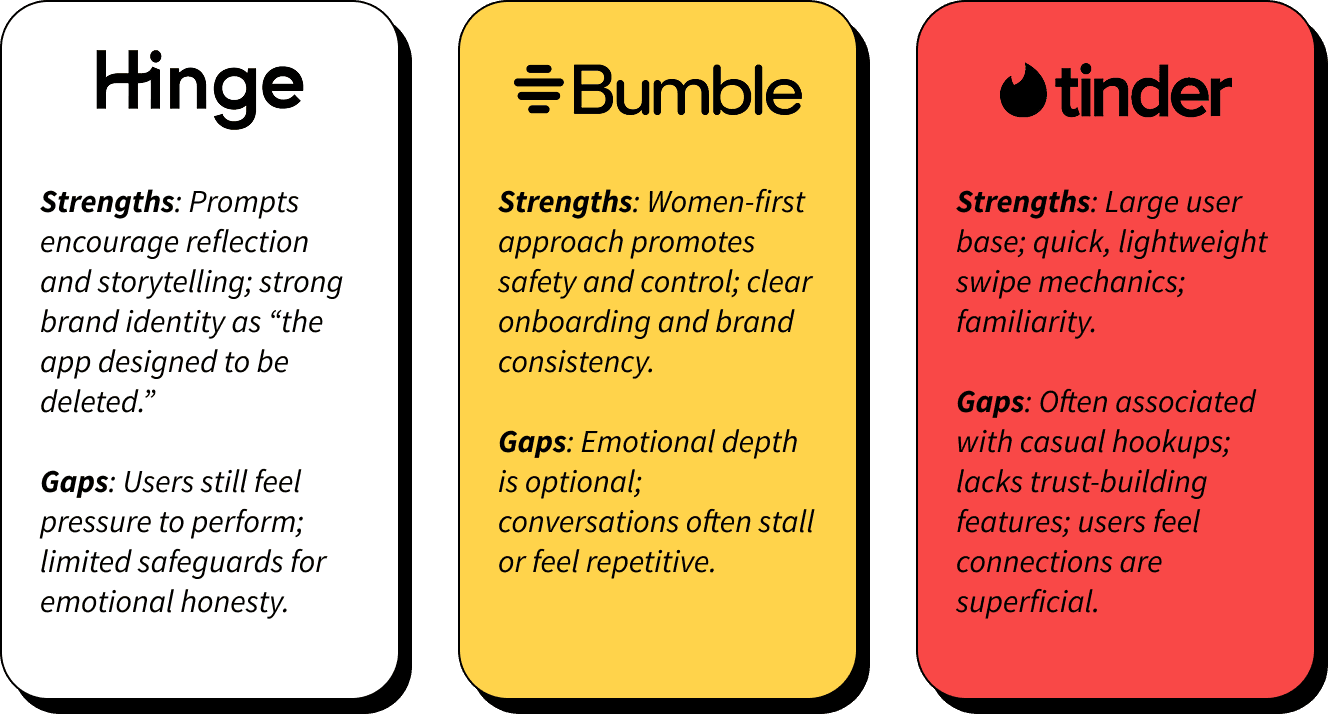
To understand the online dating landscape, I analyzed several leading apps, Hinge, Bumble, and Tinder - focusing on how they handle authenticity, emotional safety, and user experience.
Opportunities for Unlatched
Lean into emotional authenticity with dual profiles.
Provide visible trust signals to reduce fear of dishonesty.
Use guided prompts and examples to ease profile creation.
Support varied reveal flows that respect different comfort levels.
These findings highlighted the gap between user desire for authenticity and the current market’s emphasis on convenience or performance. They became the foundation for our Define phase, where I synthesized interview insights into a clear problem statement and user persona.
DEFINE
From Themes to Personas
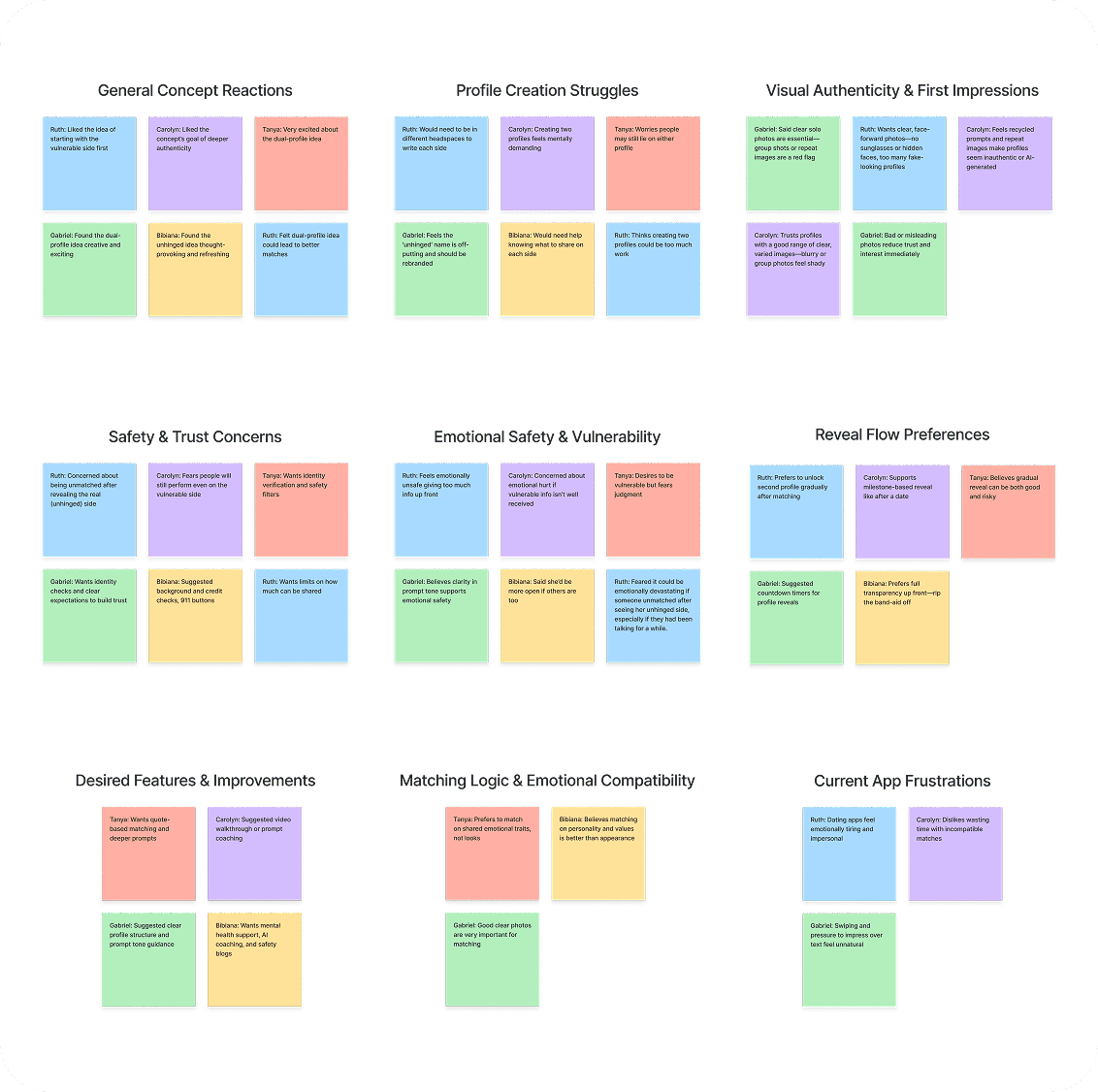
I synthesized the interviews into an affinity map, grouping themes around safety, vulnerability, reveal flows, and frustrations with existing apps.
From the affinity map, several key insights emerged:
Emotional authenticity is highly desired but must feel safe
Safety and trust are non-negotiable for adoption
People need guidance on what to share and how
There is no single preferred reveal flow
Current dating apps feel emotionally exhausting and repetitive
Users want more than just dating, they want community
Visual clarity builds trust
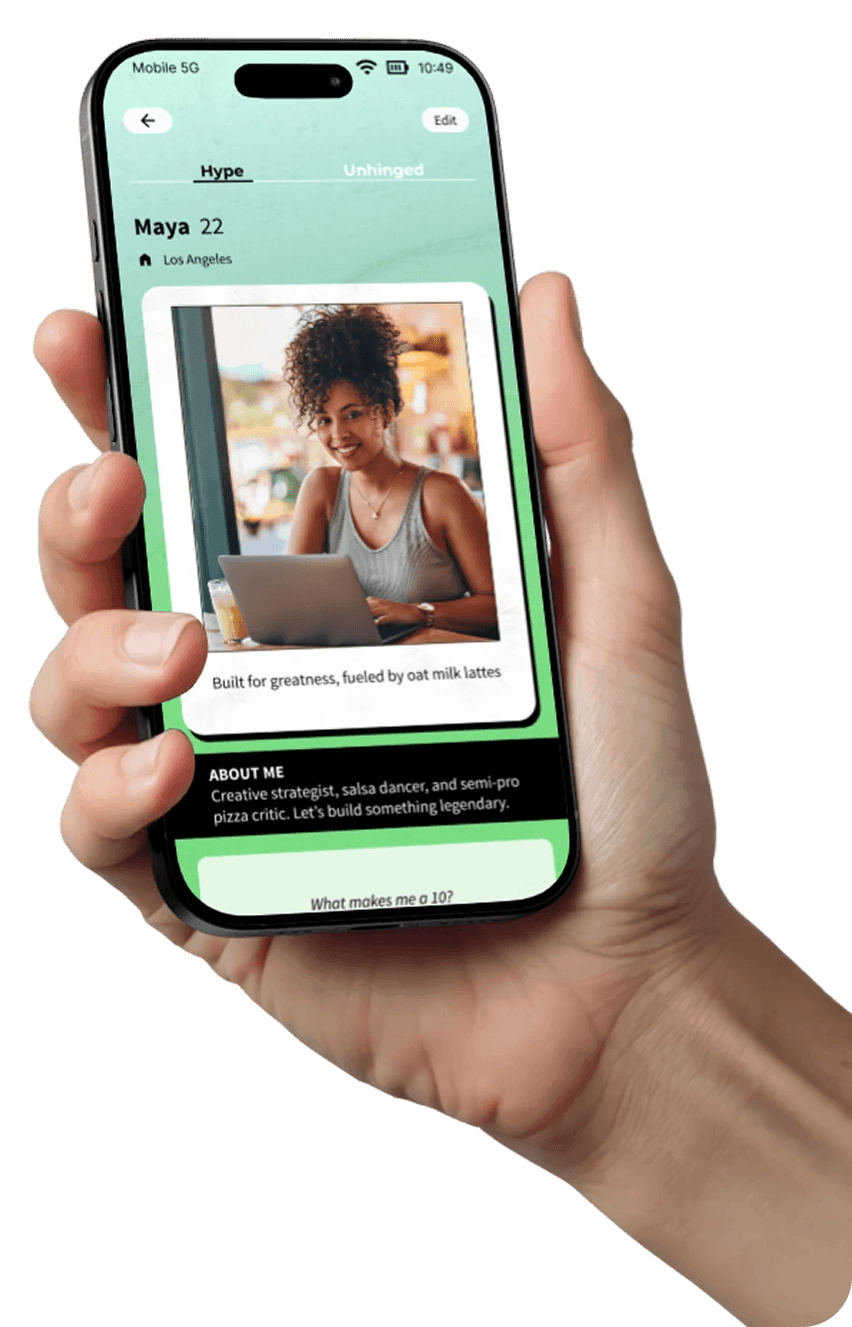
These insights pointed to a user who values honesty but won’t engage unless safety is visible and guidance is provided. One persona emerged: Maya Johnson. She was created by blending these themes into a single representative user, someone who captures the balance between caution and playfulness that participants expressed throughout the research.
Affinity Map
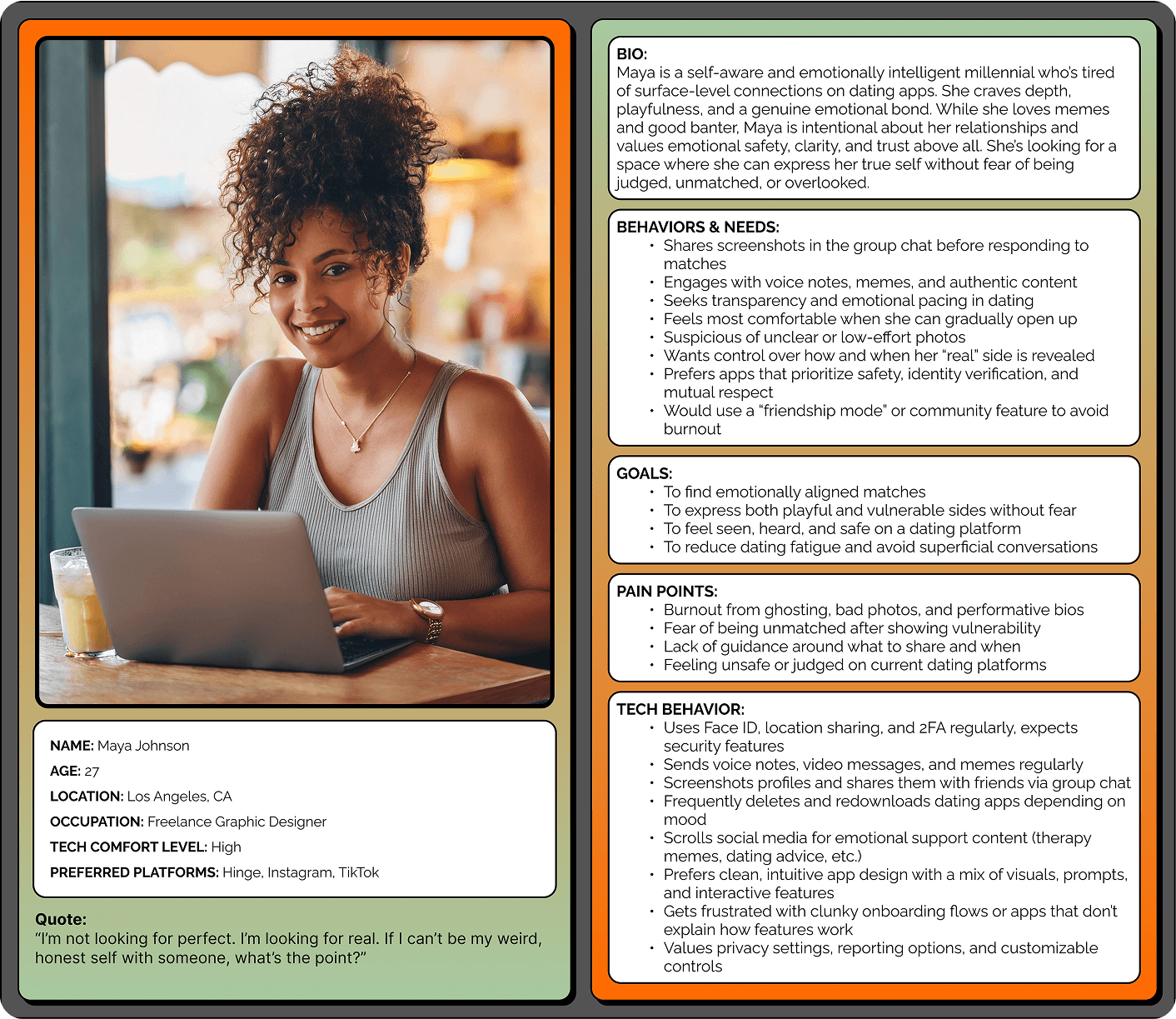
Maya was used as a reference point throughout the design process, ensuring we never lost sight of who we were creating for and grounding every decision in her needs and motivations.
PROBLEM STATEMENT
Users struggle to create dating profiles that feel authentic and safe without feeling fake or performative.
HOW MIGHT WE
Help users create profiles that feel emotionally honest, personally meaningful, and socially attractive in a way that feels fun and refreshing?
Designing, Testing, & Iterations
Making Honesty Feel Fun
From the beginning, our design philosophy was that honesty should feel fun, not intimidating. This goal became the lens for every design choice, from shortening a long, tiring flow, to refining copy so it reassured rather than judged, to introducing playful gradients that gave the app energy. Each iteration was measured against the same question: “Does this help users feel safe enough to be real, while still keeping the experience lively and engaging?”
User Flow
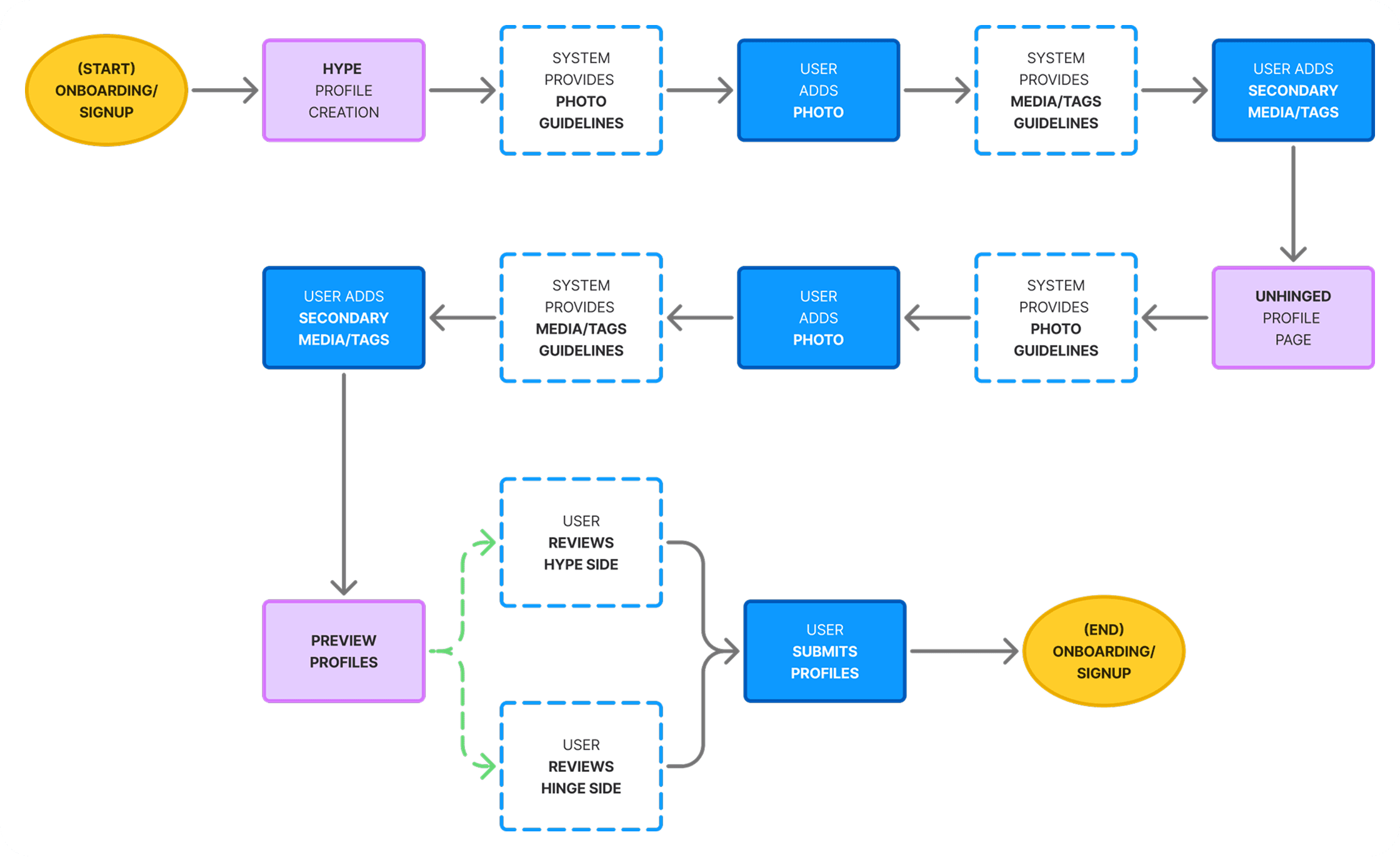
Before diving into design, we mapped the end-to-end user flow for creating and submitting both profiles. This helped simplify the process, highlight unnecessary steps, and ensure that users always felt in control.
From there, we worked in cycles of design and testing, refining the experience with each round.
Low-Fidelity Wireframes: Exploring Structure
I began with low-fidelity wireframes to explore structure, hierarchy, and the overall booking flow. My first attempt at a single-page scroll looked clean in theory but felt overwhelming. Splitting content into multiple pages gave users clarity and breathing room.
Since trust was the central challenge, I chose not to test at this stage. Users judge credibility in seconds based on visuals, so grayscale wireframes would not have produced meaningful feedback.
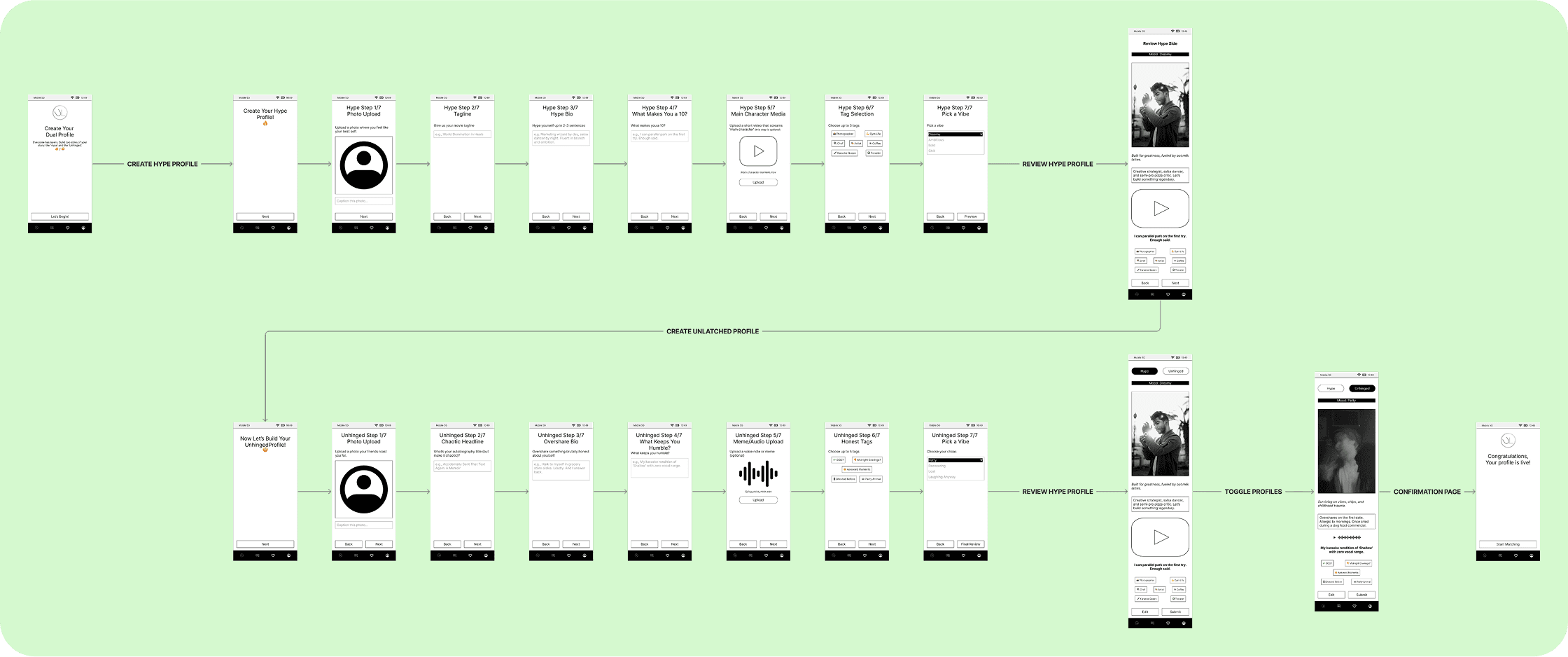
The Goal
Validate whether people could understand and complete both profiles through a basic review flow.
Testing Insights
With four participants, we validated that the dual-profile concept resonated. Users loved the emotional depth of the prompts and the chance to show both “Hype” and “Unhinged” sides. At the same time, the flow felt too long, guidance was missing, and one participant hesitated to share unfiltered content, reinforcing the importance of emotional safety.
The Goal
Even though the concept was strong, the experience needed to feel light, safe, and supportive, otherwise users would abandon it.
Impact on Design
These findings pushed us to streamline the journey, add onboarding context, and build in save options as we moved into high-fidelity.
Version 2: First High-Fidelity Prototype
The second version cut the process down from 14 screens to 3 core steps, making it faster and less intimidating. We also introduced subtle colors (blue for the main flow, green for Hype, red/burgundy for Unhinged). At the CEO’s request, we added a mood picker so users could “set their vibe” before matching.
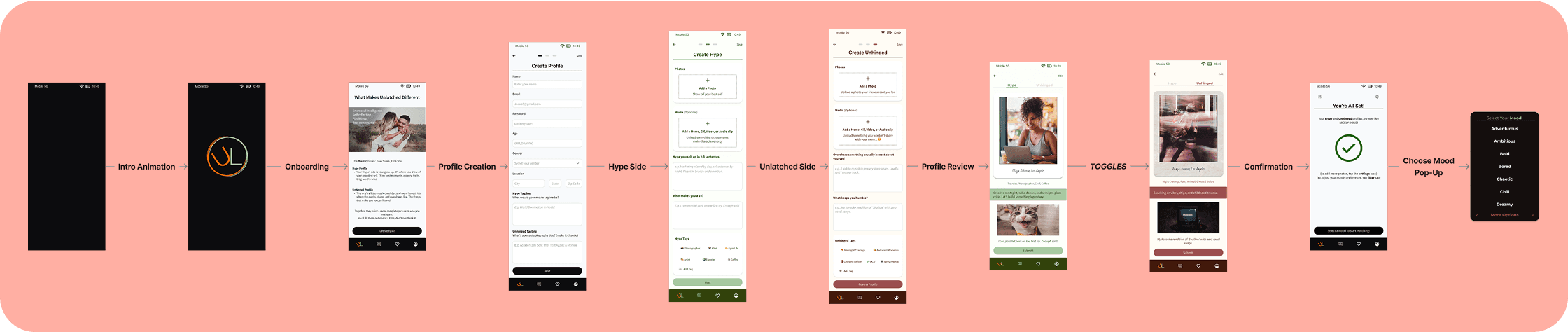
The Goal
Make the process more approachable and test whether the mood picker added value.
Testing Insights
With five participants, the streamlined flow felt faster and less intimidating, and prompt examples reduced decision fatigue. But the mood picker confused everyone, the word “Submit” created anxiety and confusion, and long taglines at the start overwhelmed users.
This round also made it clear that clarity and tone mattered as much as structure. Copy and wording could either build trust or create anxiety. One participant remarked that the interface “didn’t look or feel fun, like I’d expect from this type of dating app,” which reinforced the need for a brighter, more playful visual style.
Impact on Design
We removed the mood picker, reworked the copy to sound more supportive, simplified taglines, and redesigned the review screen for clearer hierarchy. Feedback about the visual style directly inspired the vibrant gradients introduced in the next version.
Version 3: Refined High-Fidelity Prototype
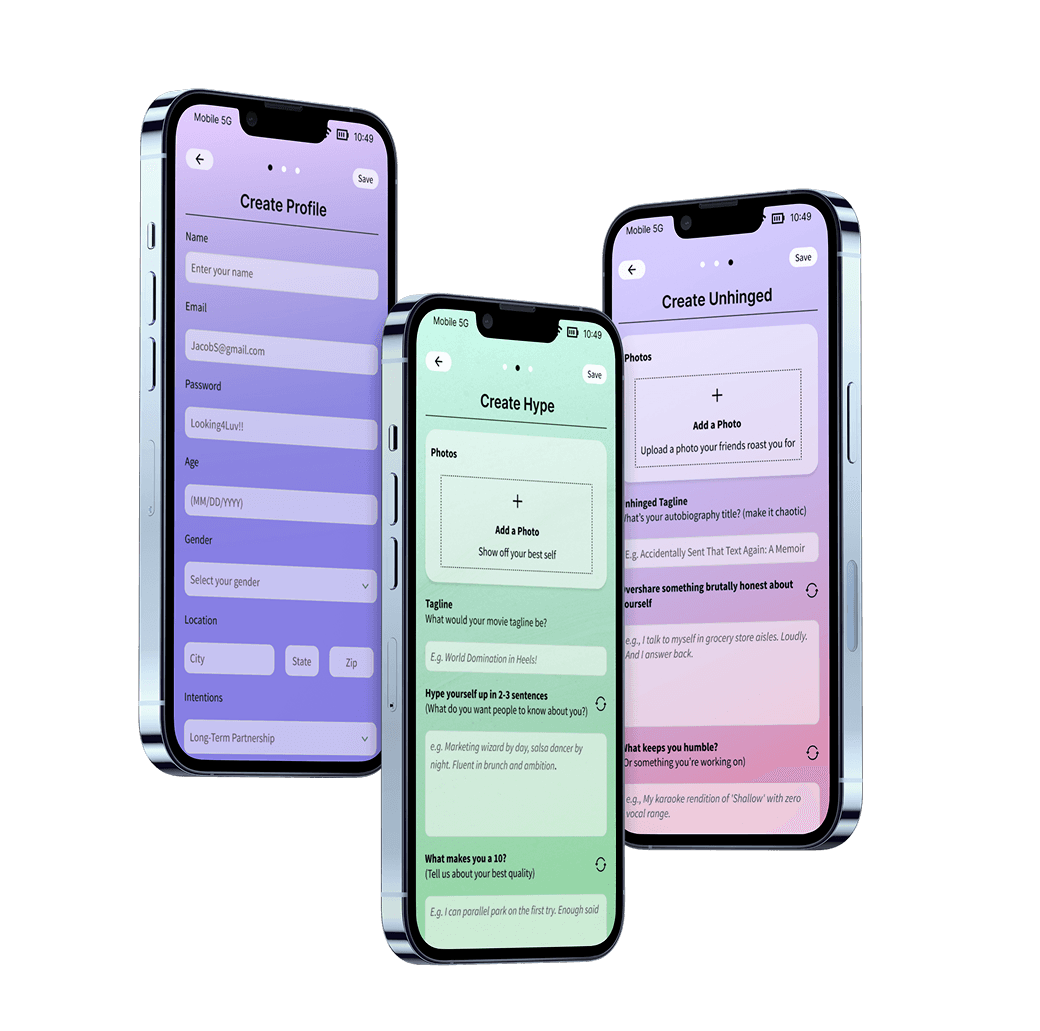
In response to the feedback from the previous version, we reworked the experience to focus on energy, clarity, and confidence. The most visible change was the introduction of vibrant gradients (purple for the core, green for Hype, pink/red for Unhinged), which gave the app a more playful and inviting feel.
We also added a submission confirmation pop-up, introduced floating Save/Back buttons, grouped review sections, and renamed tags as “Interests.” Onboarding was shortened by adding a rotating overlay screen that clearly explained the two profile types and their purpose before users began creating them. To signal future flexibility, we also included a cycling icon for prompts as a prototype placeholder showing how users might be able to swap questions in later versions.
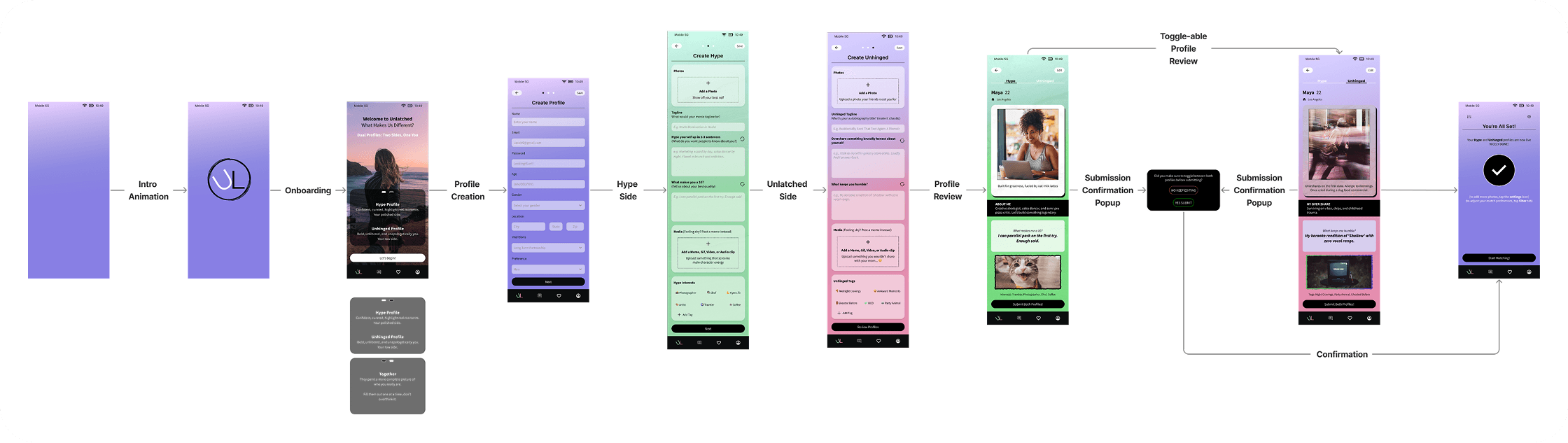
The Goal
Create a safe yet playful experience aligned with Unlatched’s values of authenticity and emotional intelligence.
Testing Insights
This version struck the right balance. Participants described the flow as safe, playful, and engaging. They felt reassured by confirmation steps, supported by micro-interactions, and energized by the visuals.
One participant summed it up: “I actually feel like I could finish this and not regret what I put in.”
Impact on Design
We validated the dual-profile flow, finalized the visual direction, validated the core flow, and built a scalable foundation to hand off as a proof of concept.
Design Philosophy: Balancing Safety and Playfulness
Looking back, what tied all three versions together was a simple philosophy: make honesty feel fun, not intimidating. Designing for emotional safety didn’t mean being serious or sterile. Through each iteration, I learned that small shifts in color, copy, and micro-interactions could dramatically change how confident and supported users felt.
By the final iteration, the experience struck that balance, playful enough to invite honesty, and safe enough to support it. Vibrant gradients added energy, clear copy reduced anxiety, and supportive micro-interactions (like save buttons and confirmation steps) reassured users at every stage. My goal was always to make the app feel like it was cheering users on, not judging them.
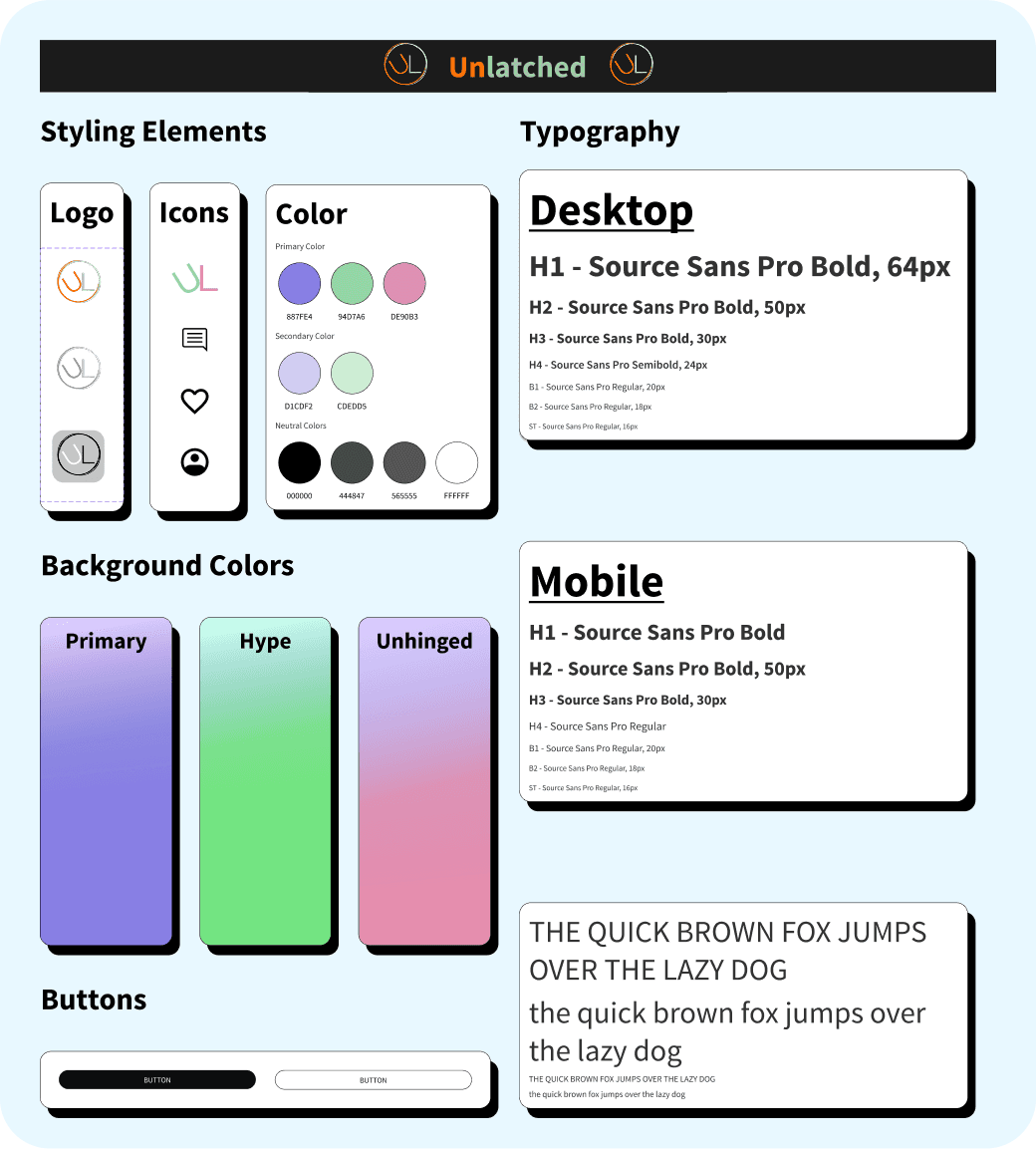
UI Kit & Components
To keep the experience consistent and scalable, I created a small UI kit/style tile with reusable components — buttons, inputs, tags, and cards. This ensured visual consistency across both Hype and Unhinged profiles, reduced design debt as we iterated, and gave the team a shared foundation for future features.
Impact & Stakeholder Feedback
The prototype became the foundation for Unlatched’s future development, shaping how the app will bring emotional authenticity into online dating. By addressing safety concerns, simplifying the flow, and layering in playful design elements, we created an experience that felt both refreshing and trustworthy to users.
Tom, the founder, was thrilled with the outcome.
“Max demonstrated outstanding creativity, adaptability, and user-focused thinking throughout the Unlatched prototype project. He went beyond the original scope, contributing additional work that resulted in polished designs and in-depth user research. His ability to pivot quickly and refine ideas elevated the quality of the entire prototype. Highly recommend this talented designer!” – Tom Colquhoun, Founder of Unlatched
Following the project, Tom invited me to continue working with Unlatched beyond the original scope, a clear signal that the work delivered real value for both the product and the team.
Final Note for Employers
This project demonstrates my ability to blend research with creative execution, adapt quickly to feedback, and design with both empathy and playfulness. I’m excited to bring that same energy and process to future challenges.
– Max Szollosi, UX Designer & Researcher